
Explore the History and Heritage of Featherstone Rovers
Ackton Hall Colliery
1873 to 1985
by Irvin Saxton
George Bradley, the owner of Ackton Hall and most of the land in Featherstone, borrowed money in 1873 to start a colliery near the railway station. He sank two shafts to the Stanley Main Seam and called it Featherstone Manor Colliery. He later had them deepened to the Warren House Seam and in good times the output was about 200 tons per day. But in 1888 trade was bad and he couldn't keep up the payments on the mortgage and he was declared bankrupt. In August 1890 Samuel Cunliffe Lister (later to be Lord Masham) bought the Ackton Hall Estates, including the colliery (now called Ackton Hall and Featherstone Manor Collieries, possibly to differentiate between the two seams), and set about a major improvement scheme including shafts to the Silkstone and Haigh Moor Seams. "Manor" was dropped from the name. In1890 the colliery was small with one coal winding shaft and the upcast shaft and a few sidings. There was also a small works to produce coke and town gas.
In 1893 during a national coal strike there was a riot at the colliery and soldiers fired ten bullets at the ground in front of demonstrators. The ricochets injured about 20 men and two died from their injuries. The official inquiry came to the conclusion the attack upon the colliery was pre-concerted and carried out by mobs from a distance. The Ackton Hall miners took no part beyond that of looking on. During the strike work on expanding the colliery continued. A tubway was made over the sidings and railway lines to enable the increasing amounts of stone and shale to be tipped at the south side of the railway.
In 1894 the Council gave permission for a bridge over Station Lane which enabled the sidings to be taken as far as Halfpenny Lane near Cressey's Corner. In 1895 it was decided to make the main entrance off Station Lane instead of Green Lane. A large office block and two houses were built.
Coal production began from the Haigh Moor Seam in 1895 and from the Silkstone Seam in 1897. In 1900 there was a visit from the British Association. The booklet printed to accompany the visit gives the output at 2,700 tons per day, the mine employed 2,200 men and boys and 160 horses, and owned 1,600 railway wagons. The booklet described the new screening plant where hand pickers removed lumps of stone and shale from the coal, and the coal from the three seams was kept apart and sorted into different sizes.
There was a serious fire in the Haigh Moor winding house in 1901 and the roof caved in. it was out of action for a few days. The next year there was a fire in the fitting shops and the damage was estimated at £100. Both fires were put out by the colliery fire brigade. In 1903 Lord Masham handed over the Featherstone estates including Ackton Hall Colliery to his second son the Hon J C Lister. (The first son who inherited the title died in 1917 so Mr Lister became Lord Masham.)
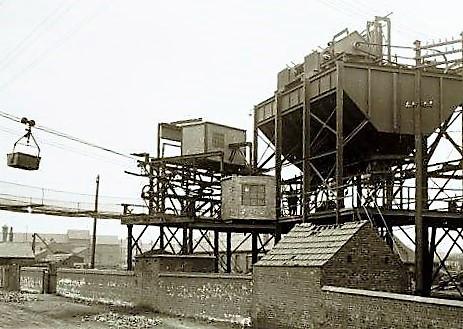
As the underground workings got further away from the shafts in Featherstone it was decided to sink another shaft at Ackworth and install a ventilating fan. Sinking commenced in 1912. There was a coal strike in 1919 and sailors were sent to some collieries in Yorkshire to keep the pumps running. The miners' union said they must not be interfered with, and they were well received in Featherstone. By the 1920's the muckstack south of the railway had reached its limit and was towering over Featherstone Square. With no more tipping space south of the railway the only way to go was north, but the original Green Lane stack was in the way. An aerial flight was installed over that stack to start another tip near Featherstone Main Colliery.
By 1924 the pit was at its peak employing 1,940 men underground and 636 on the surface. This photo shows one of the more than 2,500 workers, one of the 1,600 coal wagons and one of the 160 horses and pit ponies.

In 1924 a memorial was erected in the pit yard to commemorate the miners who left to fight in the war. In 1926 the colliery was taken over by the South Kirkby Investment Company, an off-shoot of the South Kirkby, Featherstone and Hemsworth Collieries Company, but it was kept as a separate company and remained the Ackton Hall Colliery Company until nationalisation. The Government nationalised the coal mines in 1947 and each colliery had to display a board to that effect. There was also a flag to be flown when the colliery reached its weekly output. For Ackton Hall Colliery it was 10,000 tons and the flag was regularly flown.
In 1954 the old iron bridge was replaced by a concrete bridge. The pit kept faith with its colliers and picks and shovels longer than most other pits, but in the 1950's a start was made on mechanisation. The first machines were Meco Moor Cutter Loaders which produced the lumpy coal required by British Rail and factories. But British Rail changed to diesel locomotives and factories changed to electric motors instead of steam engines, and large coal was no longer a priority. Modern power stations wanted small coal so a change was made to Anderton Shearers which churned out a much smaller product.
Mechanisation failed to make the colliery profitable so in 1976 a massive surface and underground development scheme costing about £8.5 million pounds was started to increase the output from 600,000 tons per annum to 830,000. It included a new washery plant at Featherstone end and new surface buildings at Ackworth end. All the coal was brought out at the Silkstone shaft and conveyed up to the washery. The 1976 reconstruction failed to turn the finances round and as a last ditch effort it was decided to connect the workings to Prince of Wales Colliery and take the coal out there, but this scheme was overtaken by the 1984 strike. The 1984-85 year long strike resulted in spontaneous combustion in the Barnsley Bed Seam which destroyed any possibility of the colliery being economical again, and it was the first to be closed after the strike ended.
The site had to be cleared to be changed to an industrial estate. One problem was the First World War memorial. It was decided to move it to the garden on the site of Masham's Terrace. One of the last acts was the removal of the concrete sidings bridge over Station Lane in November 1986. The road was closed for two days to enable a large circular saw to cut it into sections ready for lifting. The main office block burnt down in 1991.