
Explore the History and Heritage of Featherstone Rovers
Where's George?
A little known fact is that the first time rugby league hit the silver screen was with Where’s George? a 1935 comedy starring the comedian Sydney Howard and filmed in part at Post Office Road. It was a typical 1930s British comedy/farce of its time, firmly in the tradition of George Formby based on a range of stereotypes of thick northerners, and a particularly ridiculous plot.
Where’s George? was part of a series of British films that sought to appeal to the northern industrial working classes. The introduction of talkies in the late 1920s had highlighted a particular problem for the British film industry. All of its stars spoke with posh upper-class English accents and there were almost no stars who the millions of people in the north could identify with. Comedy and sport were felt to be the best ways to appeal to this huge market.
.JPG)
Why Featherstone?
Director Jack Raymond explained that the film ".. concerns two village teams, and I wanted the sort of ground they might be likely to hire for their game, not one that obviously belonged to a big professional club." Initially the producers had asked the RFL if two sides could go down to London to film action sequences. The RFL, mindful of the deep economic depression that gripped the north, especially the mining regions, asked if parts of the film could be shot in the north.
As the film crew headed for Featherstone, the leading actor Sydney Howard was interviewed. "The wife and I were sitting in the London Pavilion watching the film ' Escape Me Never.' There are a lot of beautiful scenes in it of the Dolomites. After watching them for a time my wife said: ' Well and they're sending you to Featherstone! ' "
So in May 1935 the film crew went to Featherstone to record scenes over 5 days. Two hundred unemployed miners were hired with the co-operation of the local Employment Exchange as extras for crowd scenes at the rate of ten shillings a day which was probably more than most of them received in unemployment benefit. But such earnings had to be declared. One George Leather of Purston, for example, was fined for not declaring the £2 he earned as an extra.
.jpg)
Losing the plot
The plot revolves around blacksmith Alf Scodger’s attempts to outwit his overbearing wife and obnoxious brother in law. As a consequence, he accidentally discovers a talent for rugby and is recruited for his local Yorcaster club against Lancastrian rivals Oldcastle. The “George” of the title is a foal that Alf buys instead of a harmonium for his wife, and then loses. However, while playing in the match he shows no talent whatsoever and feigns injury to avoid any further humiliation. Forced back onto the field by his wife, Alf spots George in a neighbouring field and as he runs towards the foal, the ball is thrown to him, he catches the ball dodges the unfeasibly large full-back and scores the match-winning try.
Somewhere in the film is also a dream sequence with Alf as a cowboy.
More Featherstone connections
As well as providing the ground and the crowd, seven Rovers players took part in the filming of the match between Yorcaster and Oldcastle. Percy Morris and Johnny Malpass were in the Yorkcaster line-up. George Taylor, Harry Smith, Percy Sutcliffe, Ralph Asquith and George Johnson jnr all played for Oldcastle. The match was refereed by A.S.Dobson also from Featherstone. Most of the remaining players came from the Huddersfield and Castleford clubs. The match itself featured for about 10 minutes in the film.
.jpg)
Rovers players & officials who were part of film. Note Morris & Malpass in different shirts
Also in the film was Carver Doone, a six feet, eight inches tall Devonshire wrestler, who played the Oldcastle fullback. He was a highly successful wrestler who fought Douglas Clark, the English All-In Wrestling champion, no less than six times. Clark was better known in the north as the Huddersfield and Great Britain prop forward, and a future member of the Rugby League Hall of Fame.
.JPG)
Was it a success?
It’s hard to know what audiences made of it and there is unlikely to be anyone alive who saw it. Where’s George? premiered in Leicester Square in August 1935 and got a nationwide release. It did suffer from one unforeseen problem, however. It went on general release in late 1935 but just a few weeks later, in January 1936, the reigning monarch, George V, died. Posters asking ‘Where’s George?’ were not felt to be appropriate in the circumstances and the title of the film was quickly changed to The Hope of His Side.
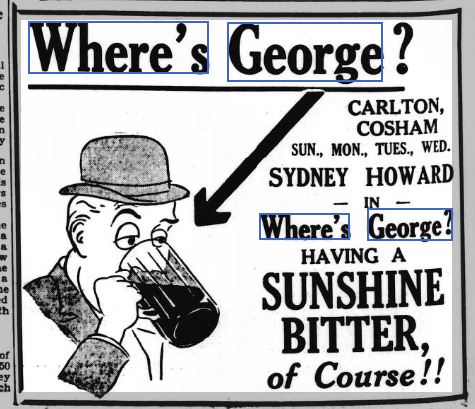
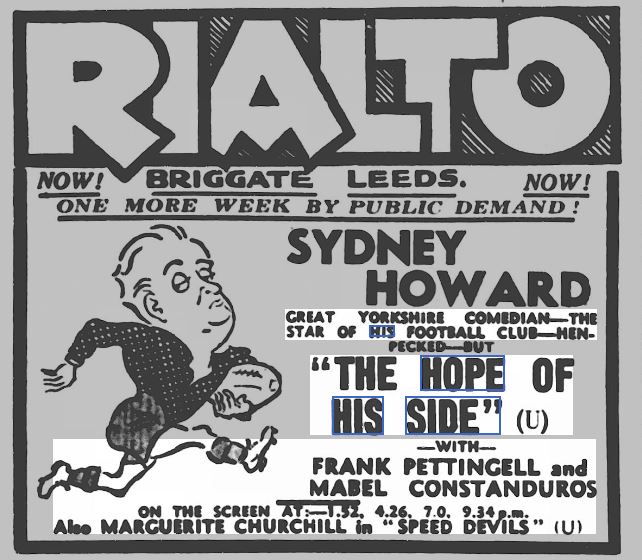
However, the film was still being shown under both titles well into 1936. It’s not known whether the film was a commercial success but there was no sequel and it quickly faded from memory.
Can I see it today?
No and it is doubtful a copy of the film still exists. Ian Clayton, in particular, put a lot effort in trying to find a copy with no success. A shame only in the sense that we don’t get to see Post Office Road and Rovers players in 1935 on film, a period when there is so very little photography and no other film.